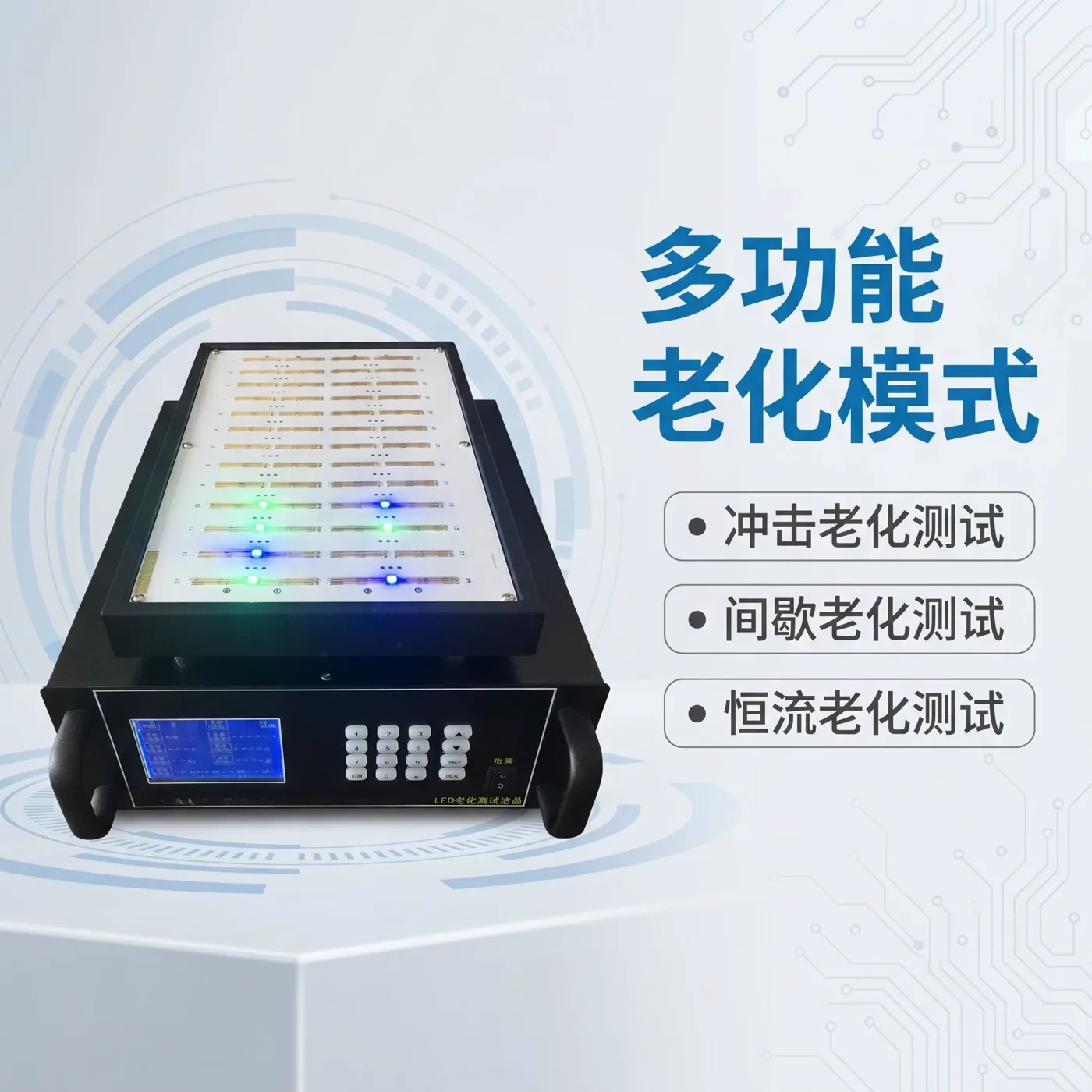
Summary
How to select an LED aging rack: positions, power margin, heat dissipation, temperature control and data logging.
Aging rack vs. aging board
An aging rack is not just a larger board. For continuous batch aging, check positions, power margin, cooling, temperature control and data logging.
Positions
Estimate the number of LEDs online at the same time:
daily aging volume × aging duration ÷ 24 h
Add about 20% margin for changeover and rework.
Power margin
- Total power = VF × current × positions
- Keep at least 30% margin on the power supply
- Use independent channels or groups to limit the effect of a short circuit
- Check wire gauge and terminals for high-current aging
Heat dissipation
Heat is the most common problem in aging racks:
- Dense LED arrays raise junction temperature
- Poor cooling produces unstable or misleading data
- Check airflow, heat sinks and fan redundancy
- High-temperature racks should hold temperature within about ±2°C
Temperature and humidity
- Room-temperature aging: standard rack
- High-temperature aging: heated and controlled rack
- 85°C/85%RH: requires a climatic chamber and dedicated fixtures
Data and traceability
Current, voltage, temperature and time logging; per-channel records; export to Excel/CSV.
Need an aging rack configuration? Send daily volume, aging conditions and LED package.
Need a test solution?
Tell us your LED package, test items and daily capacity. Our engineers will recommend a configuration.