Summary
Four factors for choosing an LED aging board: package type, number of positions, voltage/current range and fixture design.
Four factors that matter
- LED package — SMD size, pad pitch, DIP pin spacing, high-power base, RGB/addressable IC.
- Number of positions — size it from daily inspection volume, not from the lowest price.
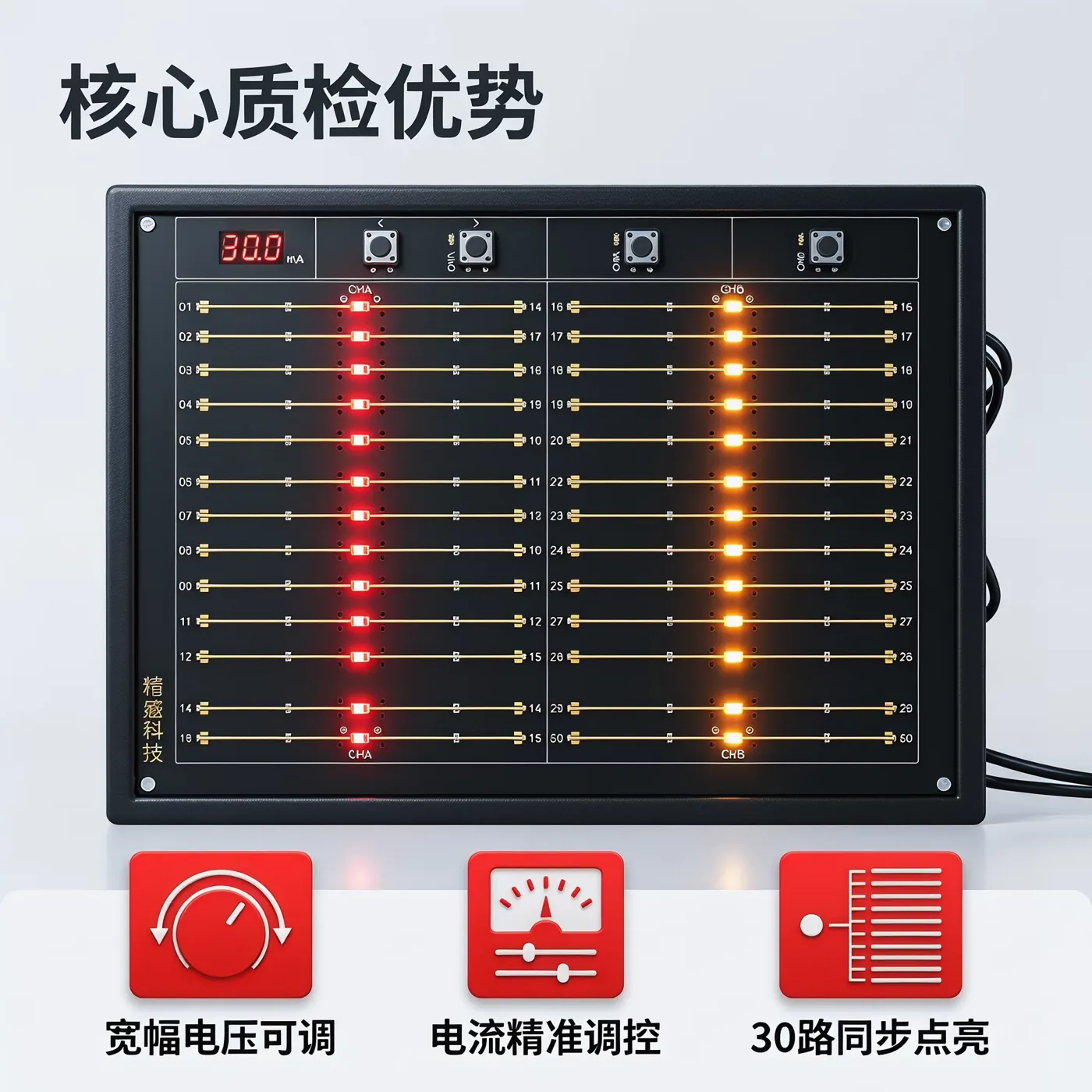
- Voltage/current range — cover the VF range with about 20% margin; use constant current and per-channel or group control.
- Fixture design — probe pressure, contact resistance, changeover, ESD and flame-retardant materials.
Positions vs. daily volume
| Daily volume | Suggested positions |
|---|---|
| < 500 pcs | 10–30 |
| 500–2000 pcs | 30–60 |
| > 2000 pcs | 60–120 or an aging rack |
Fixture requirements
- Adjustable, uniform probe pressure to avoid chip damage
- Low contact resistance for high-current tests
- Replaceable probe plates for different packages
- Good heat dissipation and ESD protection
Common mistakes
- Choosing by price only
- Too many positions without enough power or cooling
- Using a standard SMD fixture for Mini LED
- Treating addressable RGB like ordinary RGB
- No independent control when one short circuit affects a whole group
Recommendation
Validate the fixture with 20–50 real samples before placing a batch order.
Need an aging board recommendation? Send the package, daily volume and voltage/current range.
Need a test solution?
Tell us your LED package, test items and daily capacity. Our engineers will recommend a configuration.