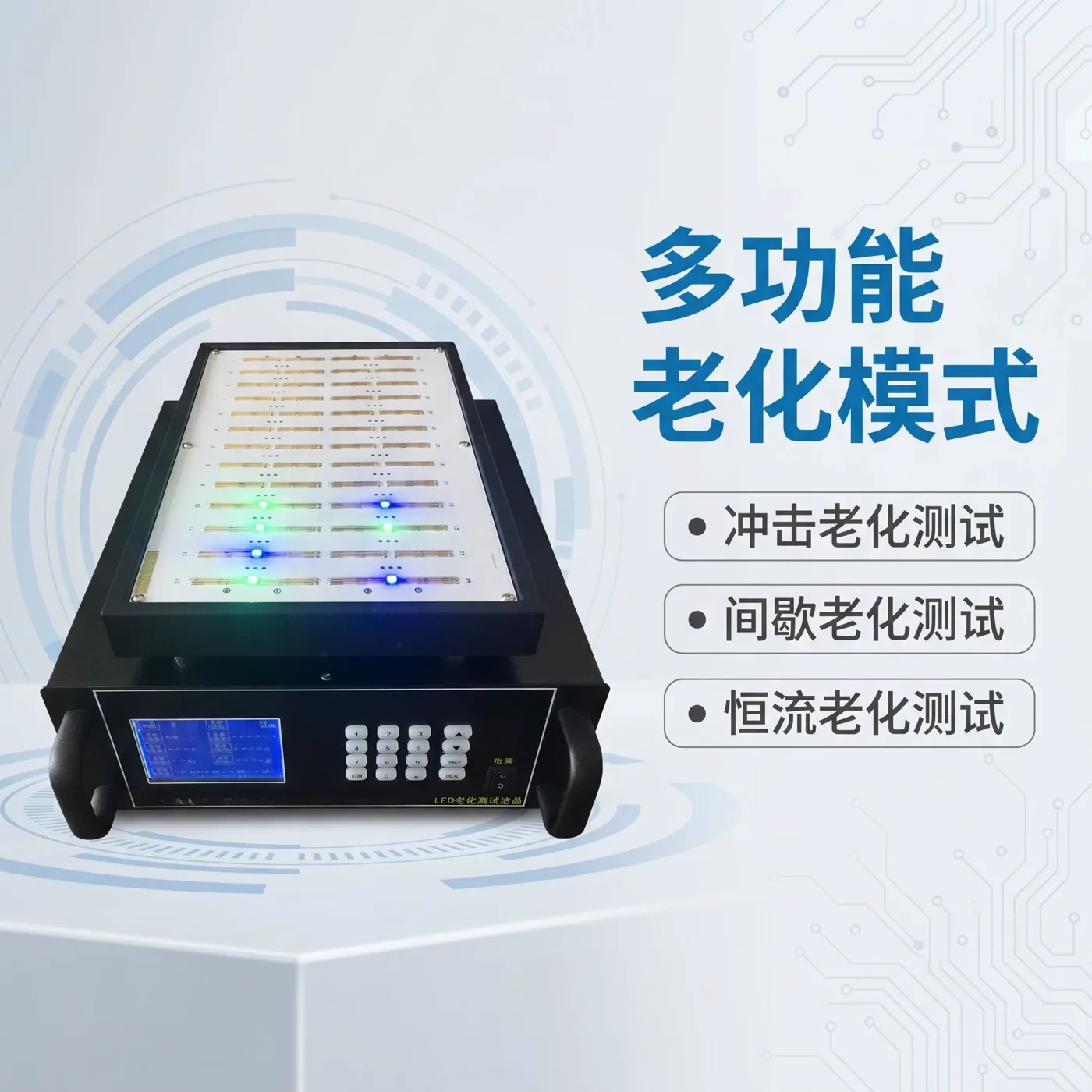
Summary
UV LED testing requires band-specific measurement: peak wavelength, FWHM, radiant power, VF, junction temperature and aging.
Know the band first
- UVA: 365/385/395/405 nm — curing, exposure
- UVB: 308/310 nm — phototherapy, horticulture
- UVC: 255/265/275/280 nm — disinfection
Different bands need different fixtures, calibration and safety measures.
What to measure
- Peak wavelength and spectrum — check against specification; abnormal FWHM may indicate a chip/package issue
- Radiant power / irradiance — use a UV-band probe or integrating sphere, calibrated for the band
- Electrical parameters — VF, IF, reverse leakage
- Junction temperature — UV LEDs concentrate heat
- Aging — record radiant power decay; UVC also needs encapsulant UV aging checks
Equipment
- Spectrometer / spectroradiometer
- UV radiometer/power meter with matched probe
- UV integrating sphere (ordinary visible-light spheres are inaccurate in UV)
- Stable constant-current source
Fixture and safety
- Quartz window or UV-transparent material; ordinary glass absorbs UVC
- Heat dissipation
- Light shielding to prevent UV leakage
- UVC eye/skin protection and ventilation
Need a UV LED test or aging solution? Send the wavelength, package and power.
Need a test solution?
Tell us your LED package, test items and daily capacity. Our engineers will recommend a configuration.